



In any business, incidents—whether minor or significant—can disrupt operations, pose risks to employees, and affect the bottom line. While some may view these events as unfortunate but inevitable, how a business responds and learns from them is critical to its future success. Incident investigation plays a pivotal role in not only addressing the immediate aftermath but also in preventing future occurrences. Here’s why it’s essential to take incident investigation seriously.
1. Understanding Root Causes
The primary goal of an incident investigation is to identify the root cause of the event. It’s not enough to simply address the symptoms. By digging deeper and asking the right questions, businesses can uncover the underlying factors—whether human error, mechanical failure, or procedural shortcomings—that contributed to the incident.
For instance, if a machinery malfunction occurs, the immediate fix might be to repair the equipment. However, the investigation could reveal that poor maintenance or insufficient staff training played a role, offering a more sustainable solution to prevent recurrence. Understanding these root causes helps a business to rectify the underlying issue, rather than just patching up the surface problem.
2. Promoting a Safety Culture
Conducting thorough and transparent incident investigations sends a clear message to employees: safety is a priority. When staff see that their concerns are taken seriously, it fosters a workplace culture where they feel empowered to report near-misses or potential hazards before they escalate into serious incidents.
A proactive approach to incident investigation shows a business’s commitment to its employees’ well-being. Over time, this can reduce the overall number of incidents, boosting morale and productivity, while also reducing the costs associated with workplace injuries or operational disruptions.
3. Compliance and Legal Requirements
Investigating incidents isn’t just good practice; it’s a legal requirement. Various regulations and compliance standards, such as those set out by the Health and Safety Executive (HSE) in the UK, mandate businesses to report and investigate incidents that lead to injury or illness.
Failure to comply with these legal requirements can lead to severe penalties, including fines or even criminal charges in extreme cases. Thorough incident investigations help ensure that businesses meet their obligations and avoid the potential legal ramifications of non-compliance.
Beyond safety regulations, incident investigations can also be vital for meeting industry-specific standards. For instance, ISO standards, such as ISO 45001 (Occupational Health and Safety Management), require organisations to continually improve their safety performance. A strong incident investigation process supports this continuous improvement cycle.
4. Preventing Future Incidents
One of the most significant benefits of incident investigation is the ability to prevent similar incidents from happening again. Once the root cause has been identified, businesses can put in place corrective actions, such as revising policies, upgrading equipment, or enhancing employee training.
Learning from incidents, both major and minor, is crucial for long-term success. When businesses fail to investigate incidents properly, they risk repeating the same mistakes. Over time, these repeated mistakes can lead to larger, more costly incidents that could have been easily prevented.
5. Protecting Reputation and Reducing Costs
Businesses today operate under intense scrutiny, with the speed of information sharing faster than ever before. A serious incident, particularly one that leads to injury, environmental harm, or significant financial loss, can quickly damage a company’s reputation. In some cases, the reputational fallout from a poorly managed incident can be more costly than the incident itself.
By thoroughly investigating and addressing incidents, businesses can demonstrate to customers, partners, and regulators that they are responsible and committed to high standards. Furthermore, by preventing incidents, businesses can avoid the direct costs associated with downtime, repairs, legal fees, and potential fines.
6. Continuous Improvement and Learning
Incident investigation is not just about finding faults; it’s about learning and improving. Every incident offers a learning opportunity. Businesses that embrace incident investigation as a tool for growth can evolve faster and more effectively than their competitors.
Regular reviews of incidents can highlight patterns or recurring issues that may not have been apparent at first. This broader understanding allows businesses to refine processes, introduce better controls, and improve overall performance. Incident investigation, therefore, plays a crucial role in fostering a culture of continuous improvement.
How Quadra Can Help with Incident Investigation
At Quadra, we specialise in helping businesses strengthen their incident investigation processes, ensuring compliance with legal and regulatory standards while promoting continuous improvement. As an ISO consultancy with extensive expertise in health and safety management, we provide tailored support to help organisations uncover the root causes of incidents, identify areas for improvement, and implement effective corrective actions.
Our services include:
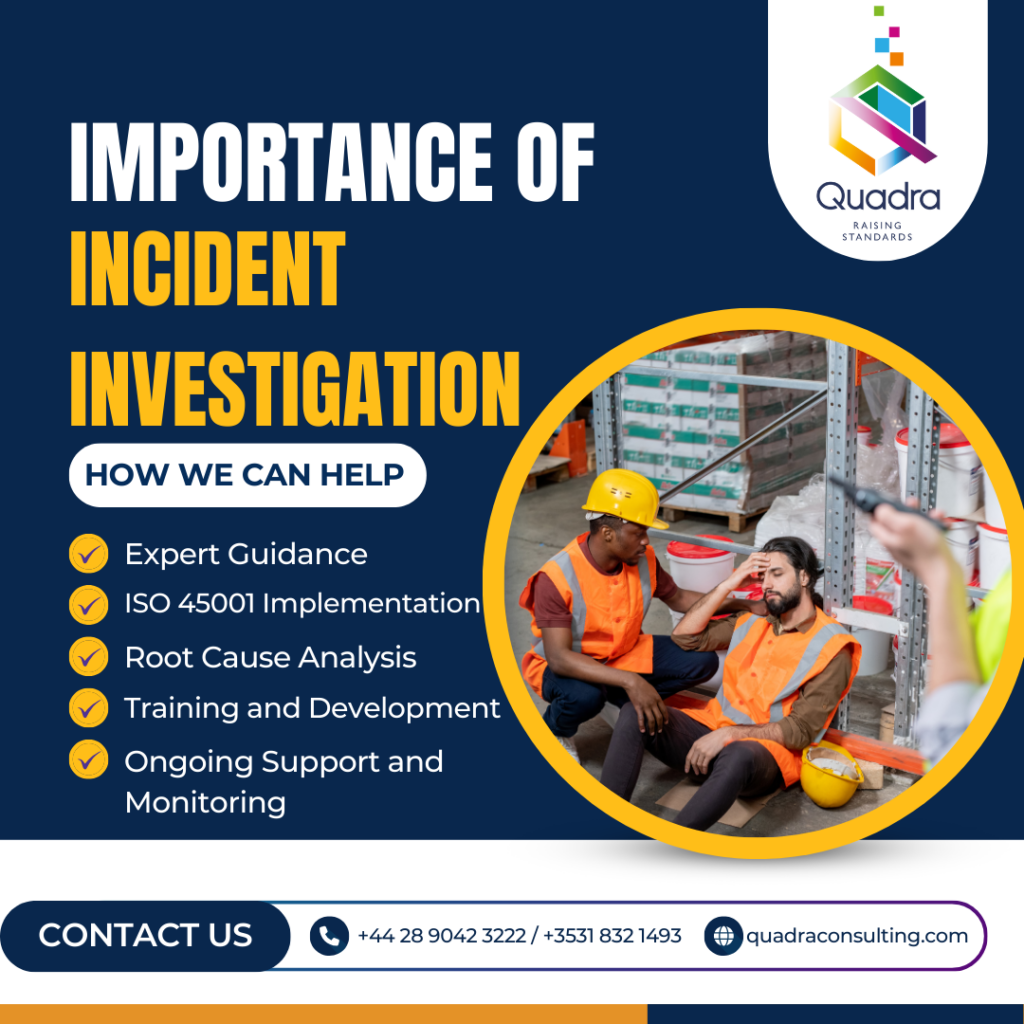
- Expert Guidance on Incident Investigation: We work closely with your team to develop and refine your incident investigation processes, ensuring they are thorough and aligned with best practices. This helps businesses not only meet compliance requirements but also drive meaningful improvements in safety and operational performance.
- ISO 45001 Implementation: If your organisation is looking to implement or improve your Occupational Health and Safety Management System (OHSMS) according to ISO 45001, we can guide you through the process. Incident investigation is a core element of this standard, and we help you embed it into your wider safety management framework, ensuring that lessons learned lead to tangible improvements.
- Root Cause Analysis: We assist in conducting detailed root cause analyses, ensuring that your investigations go beyond surface-level symptoms to uncover the deeper issues that need to be addressed. Our consultants bring a wealth of experience in various industries, helping you identify and address not only immediate risks but also potential future challenges.
- Training and Development: Ensuring your staff are well-equipped to handle incident investigations is crucial. Quadra offers training programmes to help your team develop the skills they need to conduct thorough investigations and report incidents in line with regulatory and ISO standards.
- Ongoing Support and Monitoring: Once incident investigation processes are in place, we provide ongoing support to ensure their effectiveness. This includes helping you monitor trends, assess recurring issues, and continuously improve your approach to health and safety.
Whether you’re aiming for compliance with ISO standards, meeting industry regulations, or simply looking to build a safer and more efficient workplace, Quadra’s expert consultancy can help you achieve your goals. Let us help you turn every incident into an opportunity for growth and improvement.
By partnering with Quadra, your business can ensure it is fully equipped to handle incident investigations, reduce risks, and foster a culture of safety and continuous improvement. Contact us today to learn how we can support your organisation.